
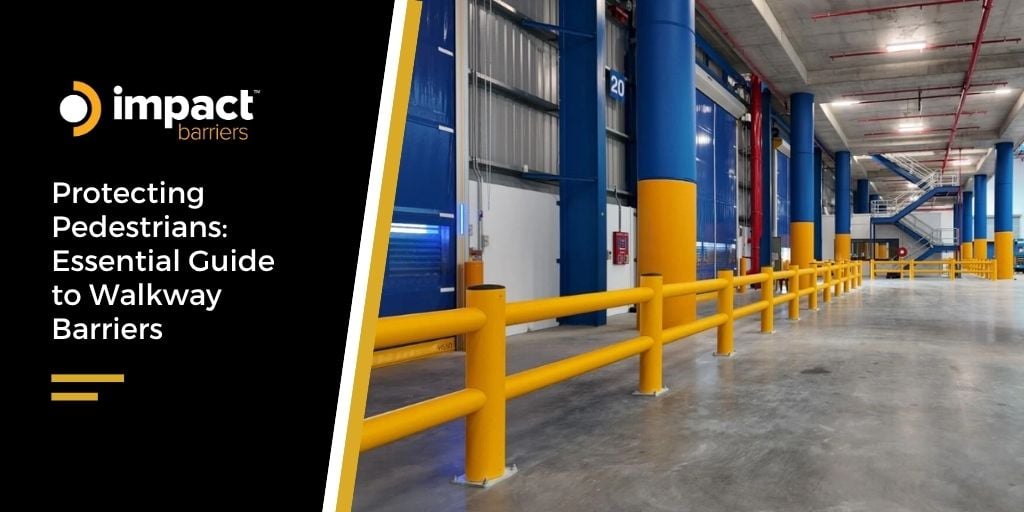
A walkway barrier is a physical structure that keeps people on foot apart from forklifts, trucks and other moving plant. It’s the difference between a pedestrian route that works when everyone’s paying attention and one that holds up when someone isn’t.
That distinction carries more weight than most sites give it. Under Australian work health and safety law, the duty isn’t to warn pedestrians that mobile plant is around. It’s to make sure the plant doesn’t hit them. Paint on a floor can’t deliver that. Walkway barriers can.
This guide covers where barriers belong in a working facility, how to choose the right one, and the installation details that quietly undo the protection you’ve paid for.
Painted lines are a control, but not a strong one
Safe Work Australia ranks control measures from the highest level of protection down to the lowest. Physical separation using barriers sits in the isolation band, near the top. Line marking, signage, speed limits and training sit in the administrative band, two levels below. That ordering isn’t arbitrary. It reflects how each type of control fails. You can read the full ranking in the General guide for workplace traffic management.
An administrative control works while people follow it. An isolation control works when they don’t.
A yellow line depends on an operator seeing it, a pedestrian staying inside it, and both doing so at 3pm on a Friday in the middle of a pick rush, with a loaded mast blocking half the operator’s view. A barrier doesn’t depend on any of that.
None of which means you should rip up the paint. Marking, signage and induction training all still matter, and Safe Work Australia treats them as part of the mix. The problem is when the paint is the only thing standing between people and plant.

What the law expects
Under the model WHS Regulations, the person with management or control of powered mobile plant must ensure the plant does not collide with pedestrians or other powered mobile plant. A separate subclause requires a warning device where a collision is possible.
The wording of that first duty is worth sitting with. It doesn’t say reduce the chance of a collision. It says ensure it doesn’t happen. A warning device sits alongside that duty rather than in place of it, which is why a reversing beeper on its own has never been a defence.
Clause numbering varies slightly between jurisdictions, and Victoria runs its own OHS legislation with equivalent duties. Your state regulator’s site is the place to confirm the exact reference that applies to you.
Where walkway barriers earn their place
Most facilities don’t need barriers everywhere. They need them at the handful of points where a person on foot and a moving vehicle can arrive in the same square metre at the same moment.
Doorways and building entries
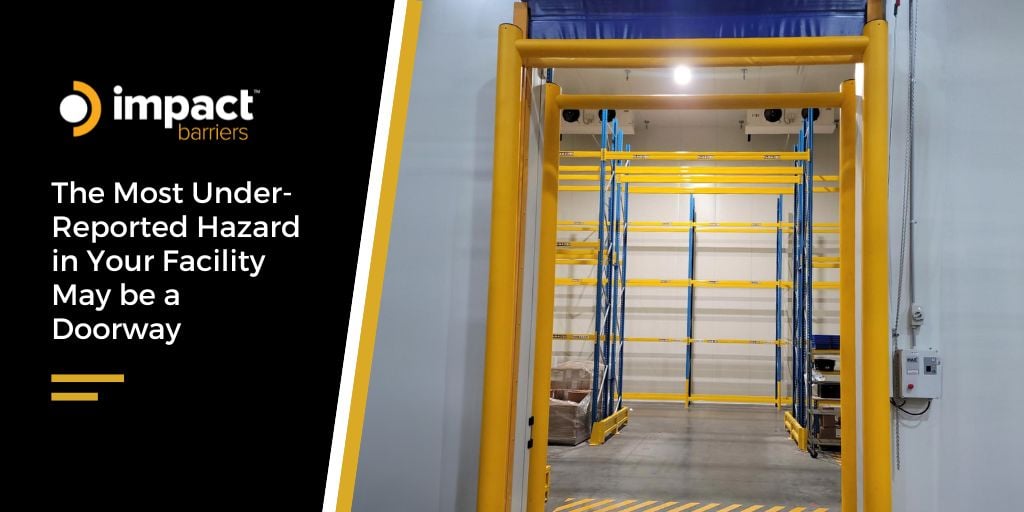
Safe Work Australia specifically lists barriers or guardrails at building entrances and exits to stop people walking straight out in front of a vehicle. A personnel door that opens onto a traffic aisle is one of the most reliable near-miss generators in any warehouse, because the person coming through it has no sightline until they’re already in the aisle.

Blind corners and racking aisle ends
The warehousing traffic management guide recommends safety railings or bollards to stop pedestrians stepping out into traffic from blind spots. Aisle ends qualify. So does any corner where racking, a stillage stack or a machine blocks the view in both directions.
Loading docks and driver paths
Visiting truck drivers are the people who know your site least and are exposed to it most. The walk from a cab to the office is often the least protected trip anyone makes on a given day. A defined, protected path from the parking bay to reception fixes a hazard that no amount of driver induction will.
Car parks and amenities
The route from the staff car park to the front door, and the route from a work area to the tearoom, get walked by everyone on site including office staff who spend no time thinking about forklifts.
Design the route people would take anyway
Safe Work Australia’s traffic hazard checklist asks a question worth putting to your own site: are pedestrian routes designed so people won’t take short cuts? A protected walkway that adds forty metres to a trip will get cut, and a barrier that gets walked around isn’t protecting anyone. Map the desire lines first, then protect them.
Choosing the right barrier for the job
Three things drive the choice: what’s likely to hit it, how hard, and what the surrounding environment demands of the material.
Duty rating and height
The Impact HDP heavy duty barrier comes in 1125mm, 725mm and 425mm heights across 1000mm, 1500mm and 2000mm bay widths. The 1125mm modules are the ones doing pedestrian separation work in a counterbalance forklift environment. The lower profiles are aimed at racking legs, plant and asset protection rather than people.
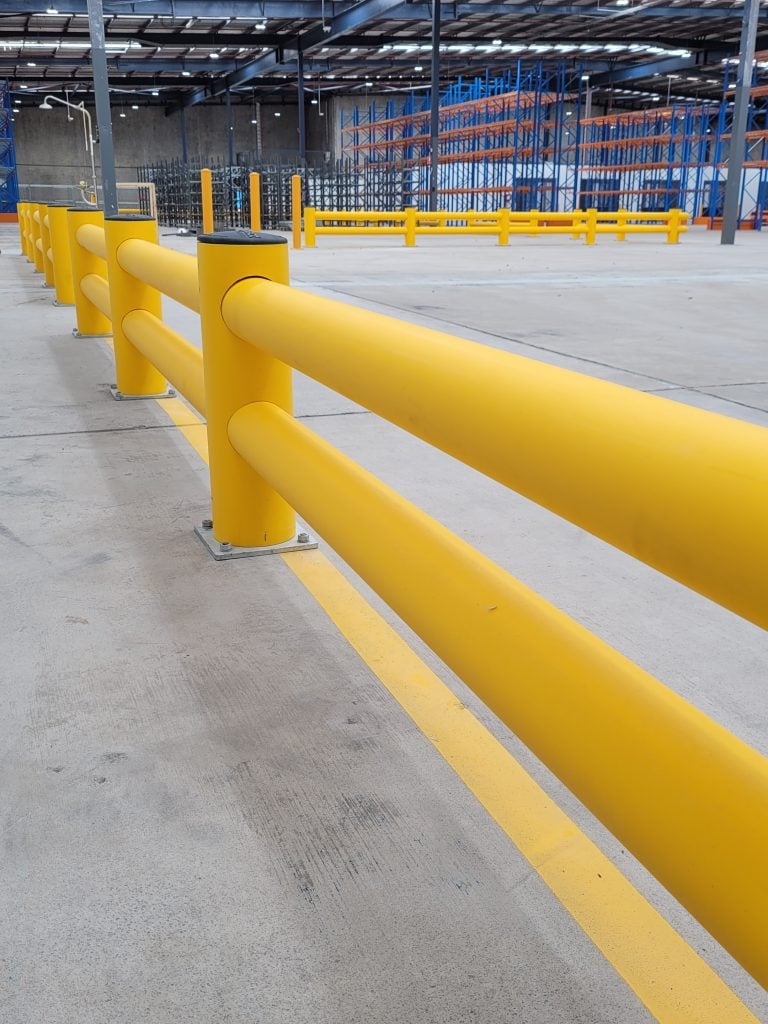
The Impact medium duty barrier comes in two rail and three rail configurations across the same bay widths. It suits segregating a walkway from a work area where the traffic is pallet jacks, walkie stackers and foot traffic rather than a loaded counterbalance at speed. Three rail closes the gap at ankle and knee height, which matters where the risk includes a pallet corner rather than the truck itself.
Polymer or steel
Polymer flexes on impact and returns to shape, so a knock doesn’t leave a bent rail that has to be cut out and welded. It doesn’t rust and doesn’t chip, which is why it turns up in food and beverage plants, cold storage and pharmaceutical facilities where a paint flake is a contamination report. It also transfers less energy into the slab, so repeated impacts don’t work the floor mounts loose.
Steel still has its place, particularly where the requirement is to stop something rather than absorb it. The honest answer is that most sites end up running both, matched to what each area is exposed to.
A run of barrier with a gap in it is a gap
This is the detail that gets skipped. A protected walkway must let people out somewhere, and an unmanaged opening puts a pedestrian into the traffic aisle at walking pace with no reason to pause.
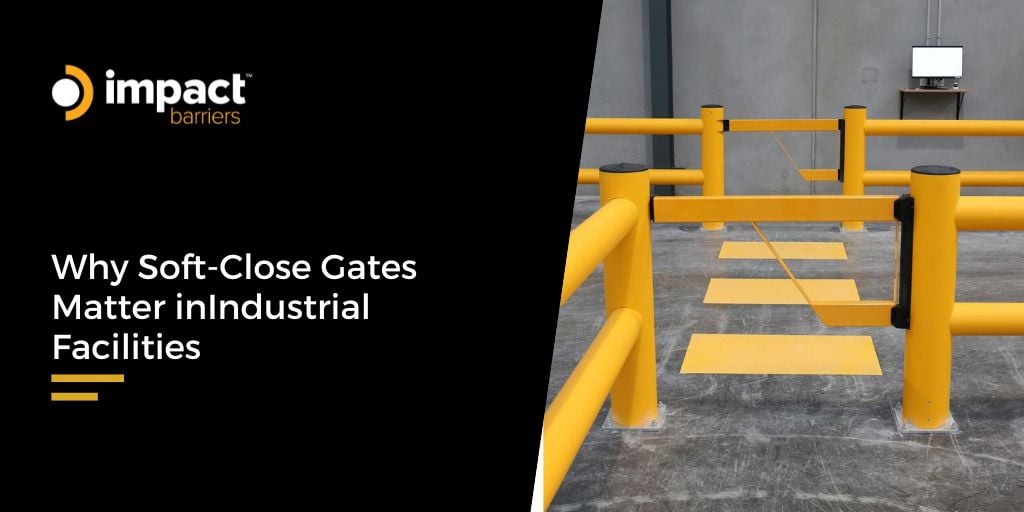
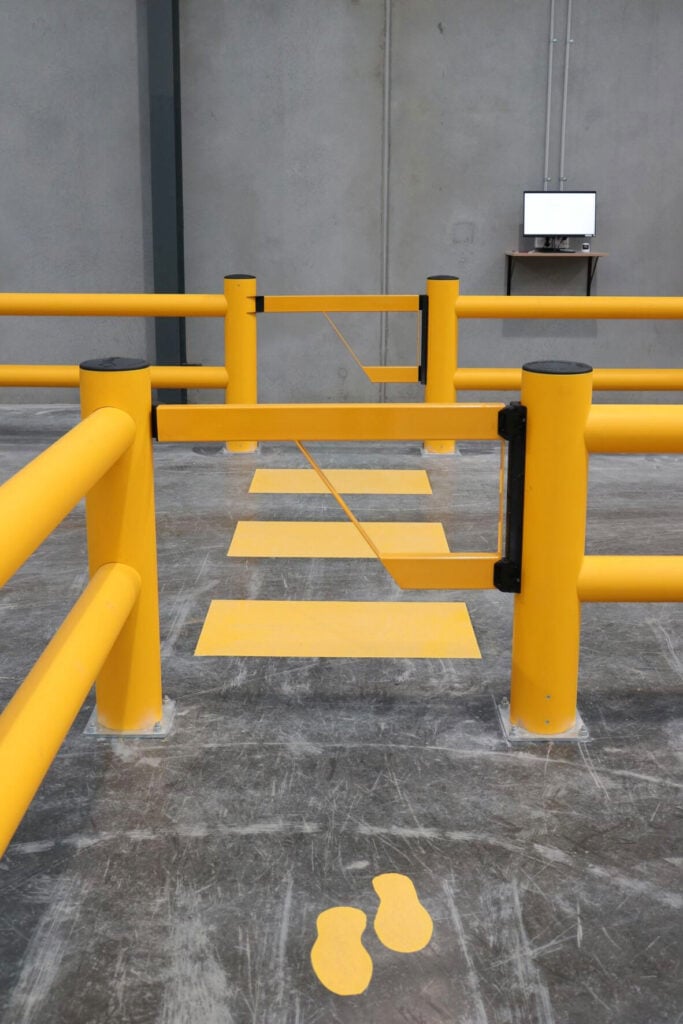
A self-closing pedestrian gate solves it. The Impact range uses a soft-close hinge and mounts either standalone or directly to the HDP or medium duty barrier systems, with single and double leaf options to suit 140mm and 200mm posts. The design intent is to break a pedestrian’s stride, so they stop, look and proceed deliberately instead of walking straight through.
Safe Work Australia’s own worked example of a loading and unloading layout shows staggered barriers used for exactly this purpose, controlling pedestrians as they approach the crossing point. It’s a recognised technique, not a product gimmick.
Installation details that get missed
- Barrier runs that end in open floor. An end bay stopping short of a wall or column is an invitation to walk around it. Close the run properly or the whole thing becomes decorative.
- Blocked walkways. The warehousing guide is direct about designing work processes so no load shifting equipment parks on a pedestrian walkway. A walkway with a pallet dumped in it pushes people into the traffic aisle, which cancels out the barrier.
- Fixings that don’t suit the slab. Polymer systems absorb impact rather than transferring it into the concrete, but the anchors still need to match the floor you’ve got. Worth checking slab thickness and condition before install, not after the first hit.
- Barriers without sightlines. A barrier at a blind corner keeps a pedestrian out of the aisle, but the operator is still blind. Pair it with a mirror or you’ve solved half the problem.
- Layouts that never get reviewed. Racking moves, pick faces change, a new dock door opens. Safe Work Australia expects control measures to be reviewed, and the barrier layout needs to move with the site rather than sitting where it was installed in 2019.
Where to start
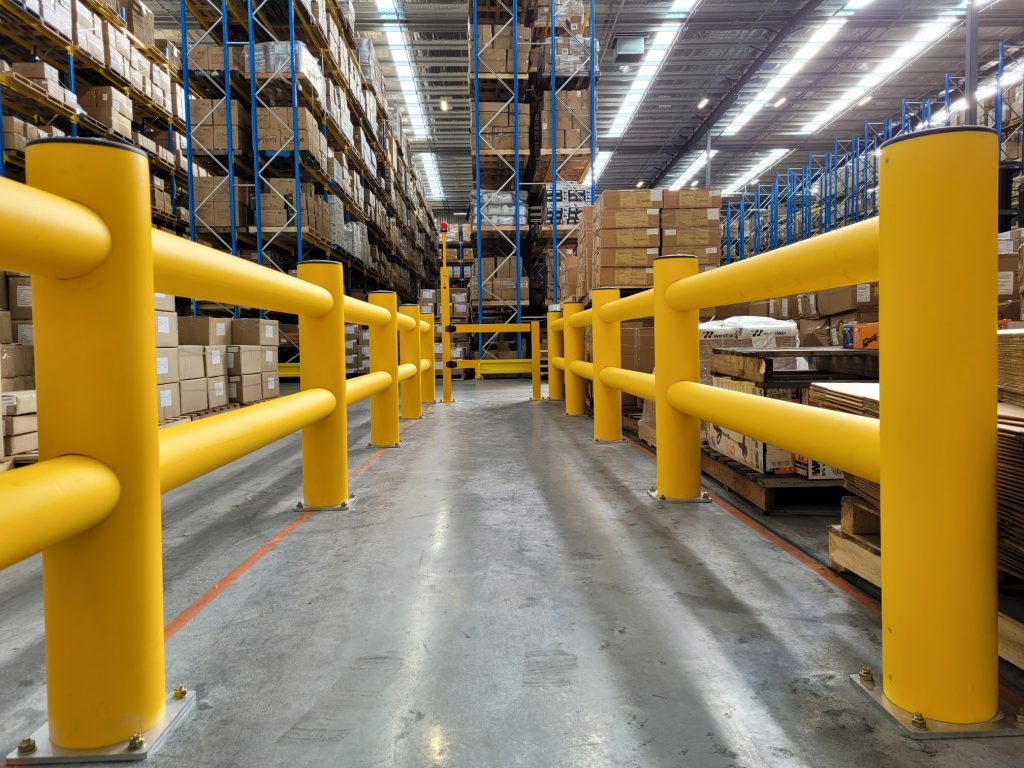
If you’re looking at your own site and aren’t sure which crossings warrant a barrier, walk it at the busiest hour rather than at 7am when it’s quiet. The pinch points show themselves.
Impact Barriers manufactures its polymer range in Australia and offers a free site appraisal, so someone can walk the floor with you and work out what each area needs before anything gets quoted. Call 1800 765 539, email sales@impactbarriers.com.au, or request a quote.